

The Multiverse of Manliness
A telescopic look at the astronomical variety in masculinities

Masculiminal has been quiet for the past few months, it’s no secret. What has this blog been doing if not putting out a constellation of sarcastic and mildly educated opinions on things? Mostly reading it turns out. Some for pleasure, some for business, and some in between. Somewhere in this journey through the milky cosmos of letters and facts it became apparent that despite having a somewhat reliable compass, the Masculiminal blog was taking it’s bearings without a map. So that’s exactly what this post is about: charting the stars in the Multiverse of Manliness.
At the center of this solar system of signores is the the concept of Hegemonic Masculinity. For context, a “hegemony” is defined as: “The position of being the strongest and most powerful and therefore able to control others”.1 Therefore, it would follow that hegemonic masculinity is the dominant or most influential idea of what masculinity is and should be. It includes a range of popular ideologies of what constitutes the ideal characteristics of “being a man”. Because of it’s idealistic nature and it’s almost unanimous acceptance in our society, it both overtly and indirectly influences the way that men behave and how women react to this behaviour. In feminist and gender studies literature, hegemonic masculinity is used to describe the conscious and unconscious patterns of practice that allow men’s dominance over women to continue throughout the world.2
Clearly a divisive and complex concept, hegemonic masculinity is also interesting precisely because it is an ideal. It is normative, but it is not statistically “normal”. In other words, it is seen as the most honourable way to act as a man, despite the fact that very few men actually embody it’s tenets. In addition to being unrealistic, hegemonic masculinity has also evolved over time in order to align with changing social, political and cultural climates. This malleability is wonderful news, as influencing the hegemony sits at the core of the Masculiminal mission.
This ancient, powerful, indestructible, and always changing view of manhood is seen everywhere in our popular media, and is exemplified most profoundly in existing members of a different multiverse… Characters like Galactus, Captain Marvel, Eternity and the Absorbing Man.
Does our bright and slowly dying sun notice the the gentle pull of the planets in it’s orbit? In the Multiverse of Manliness, The hegemonic sun not only feels this pull, but is directly influenced by it. The planets in this metaphor are other forms of masculinity, collectively dubbed “minority” or “alternative” masculinities, depending on where you look. These novel forms of masculinity do not obey a universal naming or organizational structure, and were conceived mostly to suit various specific purposes in academia. Some of the most relevant and relatable of these masculinities are highlighted below for your perusal.

Traditional Masculinity
The quintessential man’s man, traditional masculinity is the meat and potatoes of hegemonic masculinity. It is characterized by the following primary traits:
Skilled bodily activity
heterosexuality
eating meat
taking risks
sexual exploration and conquest
risk taking
avoidance of feminine behaviour
Endless striving for success and achievement
showing no weakness
seeking adventure even if violence is part of the adventure
These traits, in varying levels of intensity, make up the majority of the hegemonic ideal. This traditional take on masculinity is personified by some of the most popular and idealistically perfect Marvel heroes such as Thor, Captain America, Cyclops and Colossus.
Positive Masculinity
While not a true stand-alone minority masculinity, positive masculinity is often used in psychotherapy with young men to emphasize the positive elements of traditional masculinity. Certain ill defined yet desirable behaviours are emphasized more than others, and they are:
Bringing home a wage
sustaining a sexual relationship
being a father
Marvel men such as The Thing and Luke Cage, who both have wives, children, and jobs outside of being a hero fit this mold best.
Toxic Masculinity
The Masculiminal blog has already explored the concept of toxic masculinity in depth in it’s very first post . In order to avoid flogging a dead star-horse, all that will be said here is that toxic masculinity is an overemphasis of the traits below:
Unemotional
Independent
Non-nurturing
Aggressive
Dispassionate
Dehumanizing of other groups (usually expressed as homophobia)
Withering of empathy and emotional relatedness
This category was the most fun to compare to the Marvel supes, as some of the most entertaining super lads are toxic as hell. Characters such as Wolverine, Blade, Dr. Strange, Iron Man and The Punisher are prime examples of toxic masculinity.
Neo-Traditionalist Masculinity
This form of masculinity is very much the same as traditional masculinity with one important caveat. Men who embody Neo-traditionalist masculinity strongly and actively exhibit traditional masculine behaviours often in rebellion or revolt of changing cultural dynamics of gender equity. They are at the same time aware of and critical of changing gender roles in our society.3
A difficult and niche form of masculinity to compare to the comic book crusaders, so the closest analog that comes to mind is the universally hated Tobey Maguire black Spider-Man, AKA “Bully Maguire”.
Egalitarian Masculinity
This is the first foray into a modern form of masculinity where a strong awareness of gender equity and equality is present. This “new-age” approach to manhood is often exhibited by men who strive to actively change gender norms within their personal and intimate relationships by consciously delinking themselves from traditional masculine norms. It is important to note however that this type of masculine behaviour may still be complicit in taking advantage of hegemonic masculine power relationships in larger social contexts.4
Characters like Beast, Gambit, Mr. Fantastic, and surprisingly Deadpool (after he lets Vanessa peg him) are all supes who aren’t afraid to defer to their equally and sometimes more powerful spouses/female colleagues.
Progressive Masculinity
This celestial body of brotherhood is the furthest away from the radioactive pull of the hegemony. Progressive masculinity takes egalitarian masculinity one step further by breaking down most, if not all the traits of traditional masculinity through intense self-reflection and contemplation. In essence it is a conscious replacement of:
Stoicism with expressiveness
Competition with collaboration
Control with fairness
Power for equity
With overt social justice/gender equity activism and significant self-reflection as it’s defining characteristics, this form of masculinity is found in the likes of characters such as Professor Xavier, Vision, Miles Morales Spider-Man, and the legendary Howard the Duck.
If that was a lot of different concept to juggle in your brains all at once, fear not, because a detailed flow chart delineating the interactions of this Multiverse of Manliness has been created below.
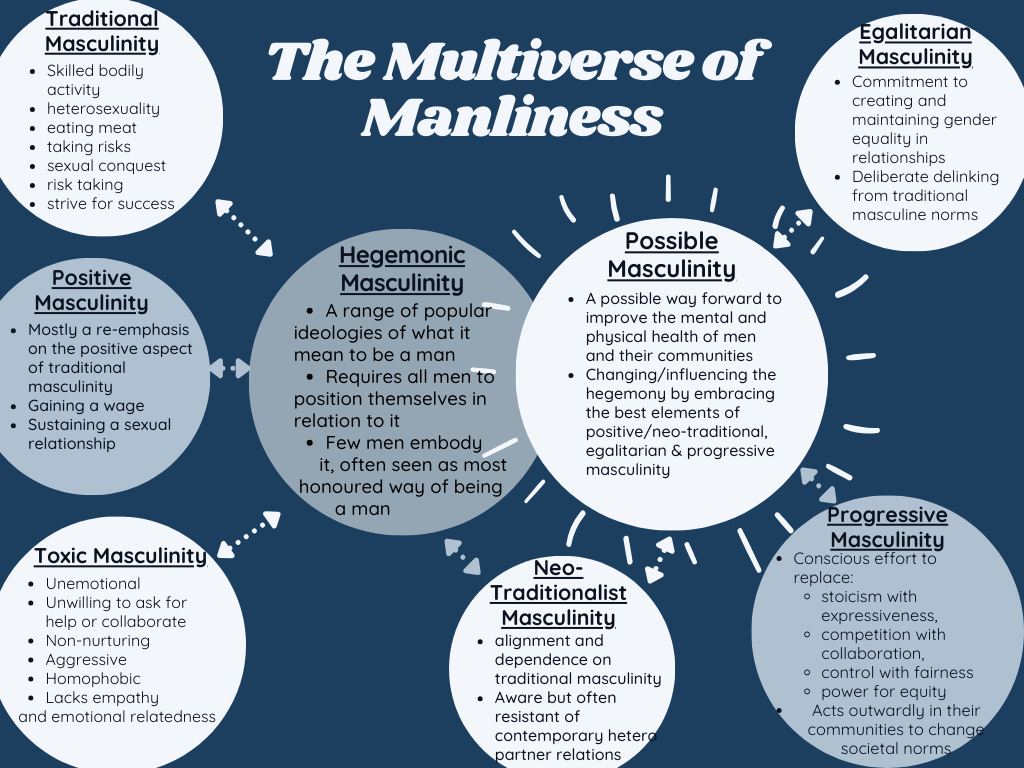
As you can see from this beautiful, handcrafted infographic, there is a mysterious and shining orb adjacent to hegemonic masculinity. Without knowing it, this is where the Masculiminal mothership has been headed all along. The wild, unknown and brilliant sphere of Possible Masculinity. If we follow the arrows on the diagram above, we can see that the hope is to incorporate elements of neo-traditionalist, egalitarian and progressive masculinity as we flesh out this undefined but optimistic future for all men. By talking about what men actually want and need, rather than what we think women, other men, and society expects from us, we can create a space where men can just be themselves. Possible Masculinity needs to be a space for the men (and women) who enjoy/choose to operate under traditional gender roles, while simultaneously shedding the rigid confines of the “protect and provide” box that men have put themselves in for hundreds of years. We need to save space for men who want to defy their predetermined roles in society and be nurturers, collaborators and home-makers. Only by opening these doors can we start to create upstream mental and physical health benefits for future men.
Looking beyond the individual heroes of the Marvel Multiverse and the examples they set for us, we can use the comic book genre as a whole as an inspiration for our path forward. Replete with cross-overs, team-ups and sub-groups, comic book heroes are constantly joining forces in order to synergize strengths and mitigate weaknesses. They are able to look past differences in beliefs, powers, and origins in order to work together to improve life around them. This is the kind of outlook we need to alter the hegemony and bring Possible Masculinity to the forefront. We need strong men, but we also need smart men, vulnerable men and compassionate men. We need to stop jockeying for the position of “Top Dog” and “Alpha male”, and instead embrace the fact that there is more than one way to skin a cat make a man. We need to widen the focus on our standards for desirability and share the spotlight with our progressively masculine heroes like Gambit, Professor X, and Beast.
In closing, with the bush now severely beaten around by the past 1,500 or so words, the first step forward becomes clear. We as a society, now more than ever, need a make-over of what type of masculine ideals we value. We need a new champion to show us what else a man can be. We need…
a remake of the 1986 Lucasfilm classic: Howard the Duck. Consider this a deadly serious Masculiminal call to action…
Last but not least, for those of you brave, patient, or bored enough to make it to the end of this rant, there is a special treat for you below. Without further ado, Masculiminal presents:
The Manly Marvel Multiverse of Madness
In a classic minimalist Venn diagram format
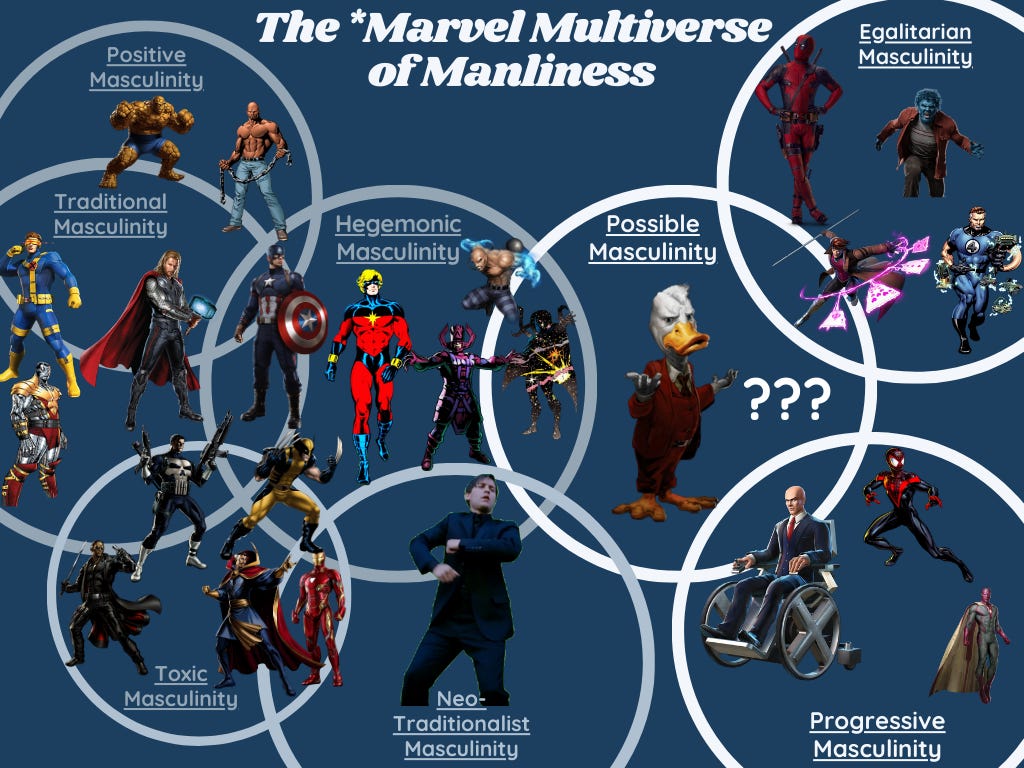
It was a real blast constructing this diagram and a lot of thought went into the placement of these heroes. If you’ve read this far, please take a moment to leave your opinion on the location of these classic characters within the various circles, or let me know which characters you would add and where. If you aren’t a comic book wiz yourself, I encourage you to share this with a friend who you think would enjoy it by smashing on that share button.
The Masculinimal blog is provided mostly for free to all readers. As always, thank you for reading. Before you go, please consider upgrading yourself or a friend to paid by clicking the button below.
While your curiosity and readership is what inspires me, cold hard cash is the only thing that will ensure the continued growth of Masculiminal as I strive to consistently produce clever and interesting content.
Peace be with you,
Greg.
https://dictionary.cambridge.org/dictionary/english/hegemony
R. W. Connell and James W. Messerschmidt. “Hegemonic Masculinity: Rethinking the Concept.” Gender and Society 19, no. 6 (December 1, 2005): 829–59. doi:10.1177/0891243205278639.
John L. Oliffe, Mary T. Kelly, Nina Gao, Jennifer Mootz, Zac E. Seidler, Simon M. Rice, “Neo-traditionalist, egalitarian and progressive masculinities in men's heterosexual intimate partner relationships.” Social Science & Medicine 333 (September 2023). https://doi.org/10.1016/j.socscimed.2023.116143
ibid.
Not the infamous Toby McGuire disco arm roll for neo-traditionalism hahahaha! I dunno that type of fanciful flourish might belong in the toxic masculinity side of things 😜.
Thanks for another great read, engaging and amusing as always!
Hi Greg, Mike Mckinnon put me on to you. Great article. I wonder if the common thread in all this masculinity is our shared unknown that leads to a desire for an identity. This identity helps us to deal with our anxiety but robs us of freedom. I wonder if the starting point for possible masculinity is our shared "lack". This opens up all kinds of possibilities - not the least humility and grace. Perhaps the scene of superheros in the bar all together, experiencing their humanty - in, I think, "the bar with no name" . Anyways nice to know of another writer around. On the Island?