

A Tincture of Testosterone
What is "Toxic" Masculinity? And is it all bad?

Over the past few years I’ve noticed a steady increase in the use of the word “toxic” to describe things other than noxious substances unfit for human consumption. The use of this word has expanded to describe any place, person, or situation that is hazardous to one’s general wellbeing. From “toxic workplaces” to “toxic relationships”, it seems anything that threatens to impinge on our mental health by causing undue stress is now being labeled as toxic. At the forefront of this toxic wave is “toxic masculinity” or the “toxic man”. So what exactly is “Toxic Masculinity”?
The last time that I remember the word “toxic” being such a familiar member of the public lexicon was in 2003, when a hyper-sexualized 22 year old Britney Spears released a smash single and music video by the same name. The sentiment of her song, as illustrated by the music video, is that despite being a flight attendant by day and the secret fourth member of Charlie’s Angels by night, Britney is no match for the “toxic” allure of the mysterious and aloof bad-boy archetype. Was Britney Spears, a timeless Pop icon of our generation, responsible for coining the phrase “Toxic Masculinity?” Fortunately for the Britney Army, the answer is no. While Britney’s depiction of a toxic man is relevant for our discussion, we will have to dig further down in the muck of history in order to uncover the roots of “toxic masculinity”.
What is Toxic Masculinity?
In his 2019 article in The Atlantic, Michael Salter explains how the first appearance of the term “toxic masculinity” came from the “mythopoetic” men’s groups of the 80’s and 90’s. Contrary to it’s intuitive association with feminism, toxic masculinity was actually coined as a label (read scapegoat) for the poor (read aggressive) behaviour of men due to the perceived “feminization” of society. These mythopoetic manfluencers of yore believed that men and boys were suffering from a lack of “masculine warrior rituals”, which in turn caused them to transform their frustrations into outward societal violence and aggression (I guess martial arts, professional fighting and contact sports didn’t exist in the 80s). This conception of toxic masculinity is based on two problematic assumptions:
All men are inherently violent and need “outlets” for said violence
Femininity is somehow lesser than masculinity and when exposed to it, men are prone to an outward expression of angst
Fast-forwarding to 2023, has anything changed? A quick Google search brings up a plethora of blog and, much to my surprise, mental health websites, all with similar vague definitions. These definitions often include a list of behaviours or attitudes that are characteristic of toxic masculinity. After boiling down the large volume of internet opinions and psychological research, I was left with the following pure distillate of toxic features:
Violence
Emotional stoicism
Need for social dominance/control
Homophobia
Misogyny
Sexual aggression towards women
If this list, which can be conveniently compressed into the acronym VENHMS, doesn’t paint a picture for you, let’s compare it to a screenshot of a recent Tweet (Or “X” or whatever) from Nick Adams:
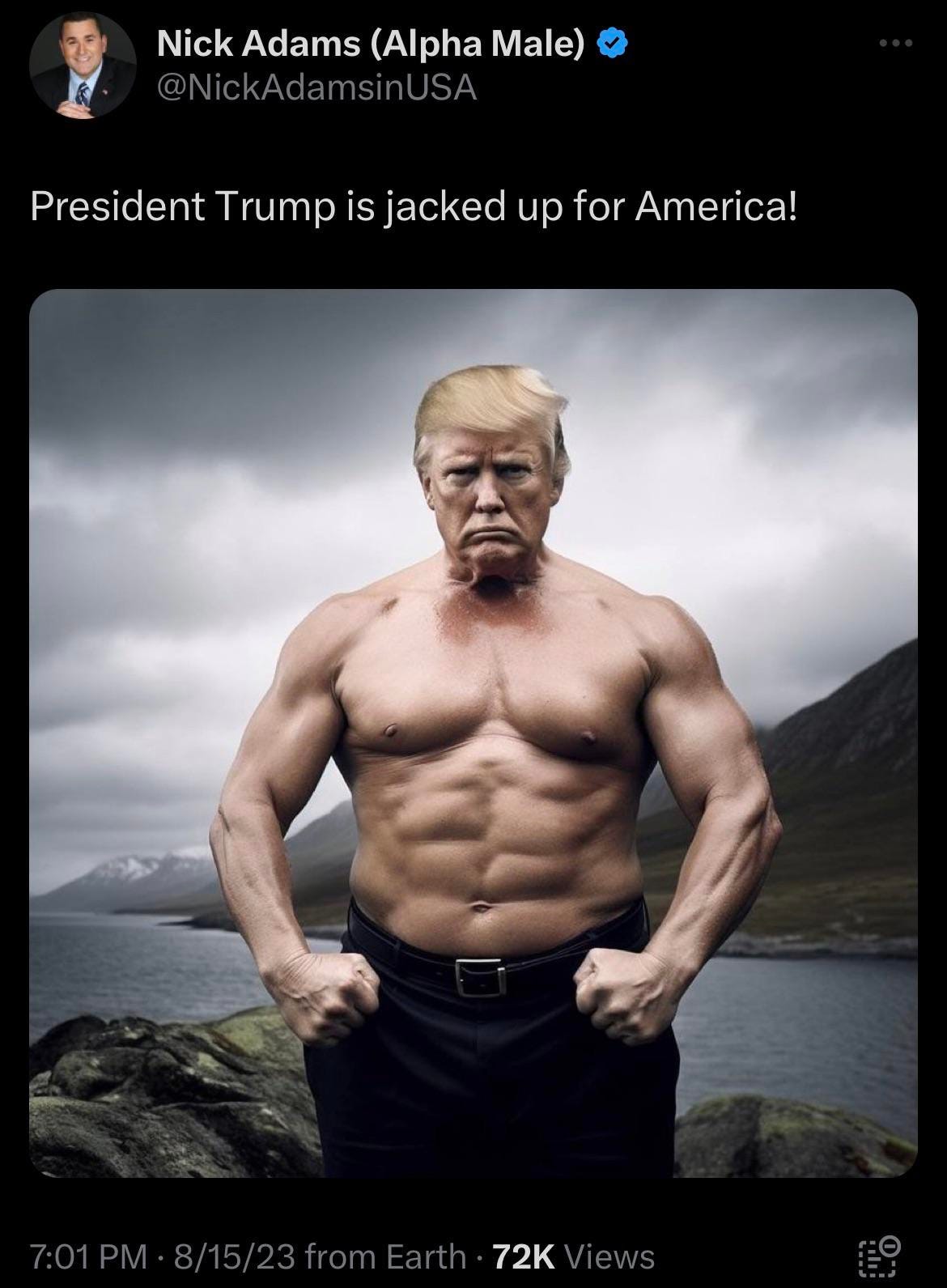
Wow! Feast your eyes on this… How many items from the list can you spot in this photo? Without even consulting the checklist this image screams: “If you want to be an alpha-male like me, you have to work out and be mean!” This image, while (hopefully) satirical, perfectly exemplifies the type of bizarre hyper-masculine motifs being promoted in our culture.
So with that image burned into your brain, and our new checklist in hand, let’s explore a more controversial question: Is it all bad? For starters, I want to make it clear that l think the last three attributes on our VENHMS list (Homophobia, misogyny, and sexual aggression towards women) are always bad and have no place in society, regardless of who is exhibiting them. But what about violence? Or emotional stoicism?
Is It All Bad?
In medicine, both holistic and Western, it is well understood that a substance that is dangerous or potentially fatal in high concentrations can serve a therapeutic effect when applied at the right time and in lower concentrations. For example Warfarin, sold under the brand name Coumadin, is commonly prescribed to people as an anticoagulant to reduce their risk of heart attack and stroke. It’s also sold (in a higher concentration) in bait blocks at Canadian Tire as mouse and rat poison. I believe the same phenomenon exists for some of these elements of toxic masculinity.
As a first responder I live in a reality where emotional stoicism is absolutely essential when faced with high-stress situations that require quick and assertive decision making. In a similar vein, I’ve experienced moments when violence was necessary to keep myself and my paramedic partner safe. These both fall into the category of “toxic masculinity”, yet nonetheless serve a beneficial purpose in our lives, if we apply them at the right time, and at the right dose.
Now that we have parsed out the truly toxic from the “maybe not so toxic”, there is a criticism of “toxic masculinity” worth discussing. Borrowing from the argument of feminist researcher Dr. Andrea Waling, using a term like “toxic masculinity” implies that it is some sort of societal disease that men can catch, rather than a set of behaviours that they choose to engage in.1 This is much akin to the “boys-will-be-boys” rhetoric, and actually worsens the problem because calling someone a “toxic male” removes accountability for their actions as “that’s just who they are”.
After looking at the evolution of “toxic masculinity” over three decades, from it’s origin in the 1980’s, to it’s pop culture appearance in the early 2000’s, to its current manifestation in 2023, we’ve seen that “toxic masculinity” is much more of a snapshot of the political climate of the moment than a concrete set of behaviours or attributes. By highlighting the dangers of callously categorizing negative behaviours as inherently male, we have now taken the first step forward in redefining masculinity for our modern age. In closing I ask you, dear reader, is there such a concept as “toxic femininity?” If yes, what does it look like?
Waling, Andrea. “Problematising ‘Toxic’ and ‘Healthy’ Masculinity for Addressing Gender Inequalities.” Australian Feminist Studies 34, no. 101 (September 2019): 362–75. doi:10.1080/08164649.2019.1679021.
All good points here as expected Dr Greg. Life is all about perspective. There is a generational divide that looms in these discussions as we all bring our unique perspective and biases forward. As someone who is an avid practitioner of emotional stoicism I can attest to the fact that it did help protect me throughout my career as a first responder but I think in retrospect it probably caused me grief in the long run with relationships.
Following the rhythm of your very insightful article, one could define “toxic femininity” as the poor behaviour of women due to perceived masculinization of society.
Its a fine line for how far the oppressed can push the oppressor before it is perceived as too far, as seen following backlash of the Me Too movement. The definition might need adapting to include that toxic traits, in this context, apply to a dominant population that abuses their power. Femininity may not yet have the ability to be toxic until females become the dominating gender in society.
That said, we might otherwise consider the ways women abuse males in female dominating fields(teaching, beauty, health, administration). In these cases perhaps “toxic femininity” might be categorized by emotional manipulation, misandry(prejudice against boys or men), or neglect/ withholding of intimacy. However, it could be argued that the need for submission(eg. housewife mentality) is only a side effect of toxic masculinity, where women have learned to internalize their sexism against other women. This can also be harmful to the male population, where they are exhausted by the pressure to present themselves as the epitome of masculinity.
In any case, its an intriguing thought that people in the modern era are leaning toward traits balanced on both the masculine and feminine sides. I wonder what implications that might have for our society in the future.